
Textile Tracking & Jewellery Security
Apparel tracked from backroom to rail, and high-value pieces counted continuously in the case.
The problem it solves
Apparel and jewellery sit at opposite ends of the same problem. One has thousands of low-value units that are hard to count; the other has a few hundred high-value ones that are hard to tag.
Apparel is a volume problem. Stock moves constantly between stockroom, floor, fitting room and back, and manual counting cannot keep pace with that churn — so the record drifts from reality between stock-takes and nobody knows by how much.
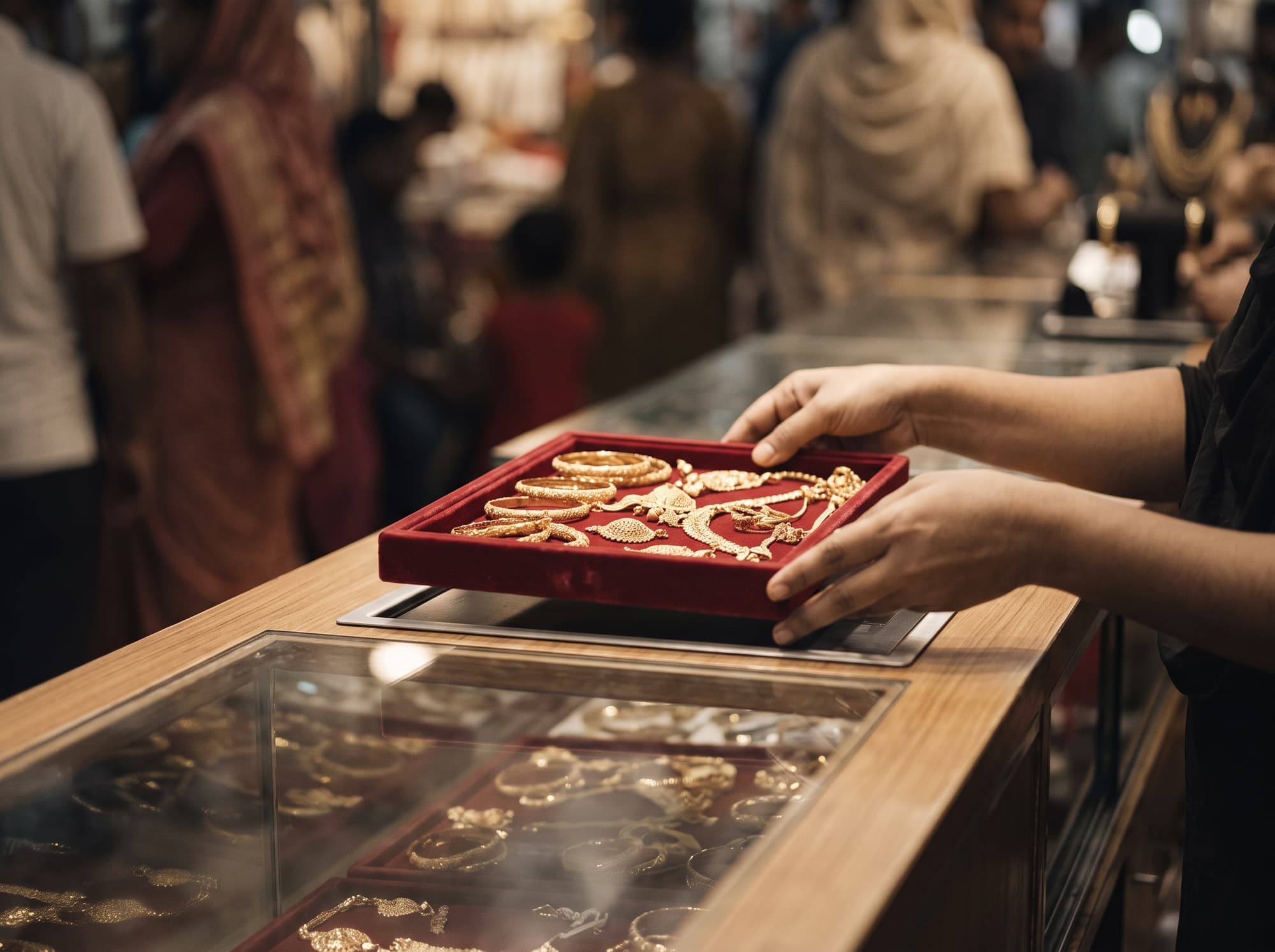
Jewellery is a physics problem. Gold and silver detune a standard inlay badly, and the pieces are too small for a conventional tag anyway. On-metal micro tags solve it, and once tagged, a cabinet reader can count the case continuously — so a discrepancy surfaces at shift change rather than at the annual count, when there is still some chance of finding out what happened.
The workflow
Four steps, in this order. A step out of sequence is a broken process, not a variation.
- 01
Tag
Apparel takes hang-tag or sewn-in inlays; jewellery takes on-metal micro tags sized to the piece, applied at receiving.
- 02
Display
Stock moves to the floor or into the case. Cabinet readers begin counting continuously from that point.
- 03
Count
Apparel is swept by handheld on a cycle; case contents are counted continuously with no staff action at all.
- 04
Alert
Variance raises against expected contents — at shift change for cases, at each cycle for the floor.
What it is
made of
Four layers, in the order data moves: a tag is read, the read becomes an event, a rule decides what it means, and a business system acts on it.
- 01
Tags
What carries the identity
- UHF apparel labels and care-label inlays
- On-metal micro tags for jewellery and watches
- PET hard tags for repeated reuse
- 02
Readers & edge
What turns presence into an event
- Handheld readers for floor and stockroom cycles
- Cabinet and shelf readers for display cases
- Stockroom portal for movement events
- 03
Platform
What decides what the event means
- Item ledger with expected-contents model
- Continuous case counting and variance alerts
- Shift-change reconciliation reports
- Movement history per unit
- 04
Integrations
What acts on the decision
- ERP
- POS
- Insurance reporting
What we supply
- 01
On-metal micro tag
Small enough for a ring or a chain, tuned to work against precious metal rather than despite it. A standard inlay simply will not read here.
- On-metal construction
- Micro formats for rings and small pieces
- Loop, adhesive or hang attachment
- Reads reliably against gold and silver
- 02
Cabinet reader
Antennas inside the display case counting contents continuously. Nobody opens a case to take an inventory; the case reports itself.
- In-cabinet antenna array
- Continuous presence counting
- Variance alert on unexpected removal
- Shift-change reconciliation report
- 03
Apparel label & inlay
Hang tags for seasonal lines, sewn-in care-label inlays where the tag needs to survive the garment's life including laundry.
- Hang tag, adhesive or sewn-in inlay
- Laundry-rated variants available
- Encoded at source or in store
- Dual EAS + RFID available
What to expect
Ranges, not single flattering figures. Baselines are captured for four to eight weeks before a pilot starts, so the delta is measured rather than claimed.
- Case variance
- Caught at shift change
- Floor stock accuracy
- 98–99%
- Count labour
- 50–70% less
- Insurance evidence
- Auditable unit history
What to plan for
Every module has a failure mode. These are the ones that actually bite on this one, and what we do about them — because finding out later costs more than knowing now.
- Precious metal detunes standard UHF inlays, and jewellery pieces are physically tiny.
- On-metal micro tags specified per piece type, with read testing on your actual product range during the survey rather than a catalogue assumption.
Your existing systems
- ERP
- POS
- Insurance reporting
Where it earns its keep
- Jewellery and watch retailers with locked high-value display
- Apparel retailers whose stockroom and floor records diverge
- Anyone needing auditable unit history for insurance
Before you
buy
The things operations directors actually ask on the first call.
Can a tag really be small enough for a ring?
Yes — on-metal micro tags exist specifically for this. They are more expensive per unit than an apparel label, which is fine, because the item they are protecting is worth several thousand times more.
Does the cabinet reader need staff to do anything?
No. That is the point. It counts continuously and raises a variance on its own; the shift-change report is generated rather than performed.
Will laundry destroy a sewn-in apparel tag?
Not a laundry-rated one. Standard inlays are not built for it, which is why we specify laundry-grade tags where the garment will be washed — the same tags used in the hospitality linen module.
The rest of retail
- 01
Return Fraud Prevention
Serialised tags linked to the sale, so a return can be checked against the receipt that created it.
- 02
Smart Fitting Rooms
Overhead readers and a wall display that turn the try-on into a conversation instead of a dead end.
- 03
Real-Time Inventory & Automated Replenishment
Item-level reads that keep store and DC stock accurate, and reorder rules that fire on their own.
- 04
EAS & High-Value Item Protection
Gates, tags and detachers you already know — with the incident data they have never given you.
- 05
Fast Checkout & Product Locator
Read a whole basket at once instead of item by item, and find the one unit that is somewhere in the store.
- 06
Supplier Performance & Automated Receiving
Validate a delivery as it comes through the door, and score the supplier on what actually arrived.
- 07
Demand Forecasting & Product Performance Analytics
Movement and sales signals turned into reorder timing, out-of-stock warnings and honest style performance.
Let's design theright system foryour floor
- Call+880 1713 819528 · 01713 222558
- Emailservice@ratsbd.com
- VisitGround Floor, House-7, Road-13, Sector 14, Uttara, Dhaka-1230
Get your quote
Tell us your store type and city. A specialist surveys your floor, recommends the exact system and sends a clear quote — no obligation.
Request a quote Chat on WhatsApp