
Fast Checkout & Product Locator
Read a whole basket at once instead of item by item, and find the one unit that is somewhere in the store.
The problem it solves
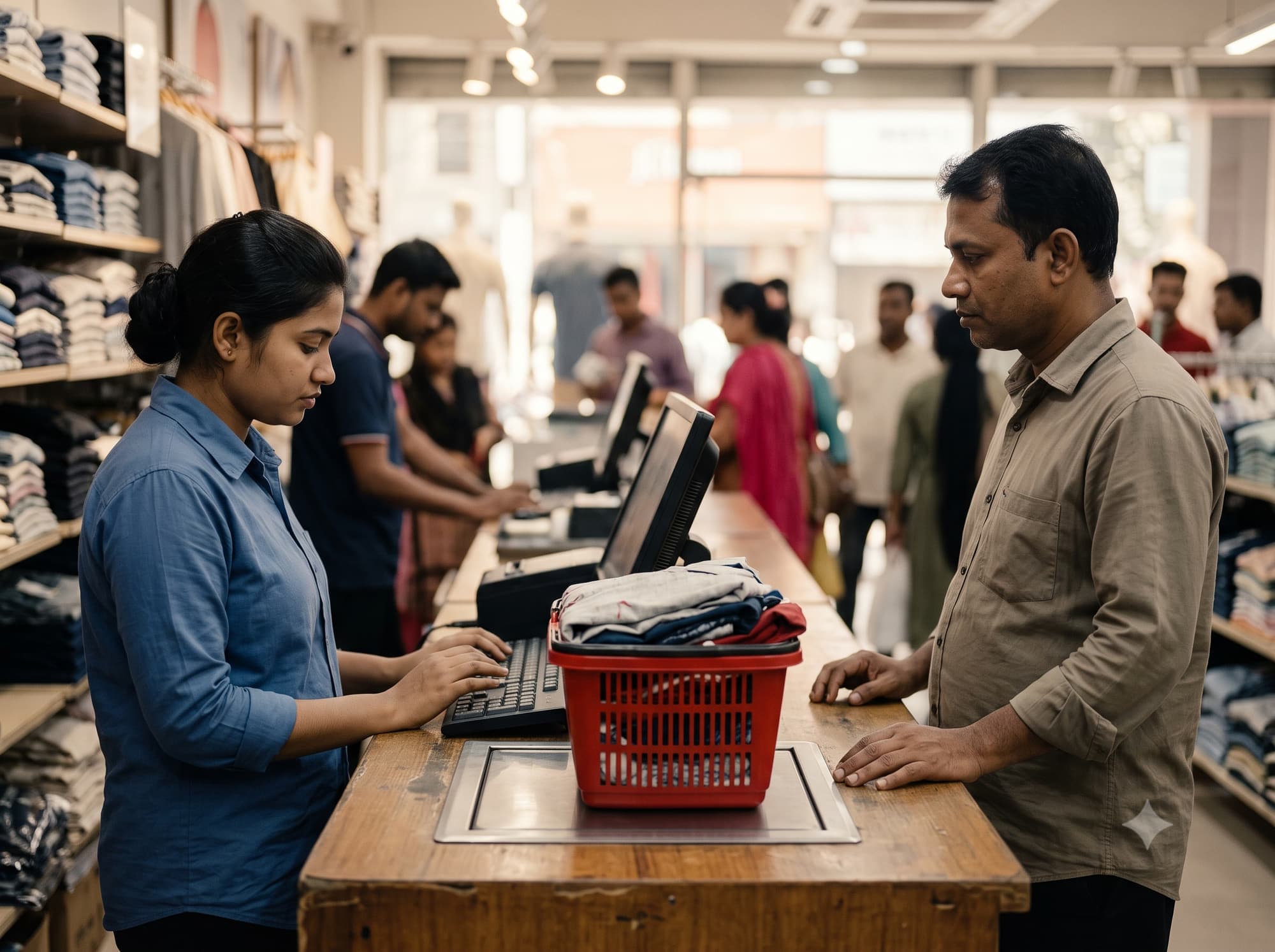
Scanning is a serial process in a world where the customer is judging you on total time. Six items means six barcodes found, oriented and beeped, while the queue behind watches.
UHF reads do not need line of sight and do not need to happen one at a time. A basket set on a counter array is read as a set — six items in the time it takes to look up. On a busy Thursday evening across four tills, that difference is the whole queue.
The same tag estate answers a second question that costs stores more sales than anyone measures: where is it. A customer wants the last size 40, the system says one exists, and nobody can find it. A handheld in locator mode plays a proximity tone that gets faster as you close on the item, and the search stops being a fifteen-minute hunt that ends in an apology.
The workflow
Four steps, in this order. A step out of sequence is a broken process, not a variation.
- 01
Present
The basket goes on the counter over an under-counter array. No unpacking, no orienting, no finding the barcode.
- 02
Verify
The item list appears for the cashier to confirm. Anomaly rules flag a count that looks wrong before payment rather than after.
- 03
Complete
Payment runs through the existing POS, and labels are deactivated as part of bagging exactly as they are today.
- 04
Locate
Separately, a handheld in locator mode homes in on a single serial anywhere in the store — proximity tone, hot and cold.
What it is
made of
Four layers, in the order data moves: a tag is read, the read becomes an event, a rule decides what it means, and a business system acts on it.
- 01
Tags
What carries the identity
- Item-level UHF RAIN
- Dual-function EAS + RFID labels
- 02
Readers & edge
What turns presence into an event
- Under-counter or overhead UHF array per lane
- Handheld readers in locator mode
- Optional self-check array
- 03
Platform
What decides what the event means
- Basket read and item-list assembly
- Anomaly rules for misreads and shortfalls
- Location service and last-seen positions
- Throughput and basket-accuracy reporting
- 04
Integrations
What acts on the decision
- POS
- Inventory
What we supply
- 01
Checkout array
Under-counter or overhead, tuned so it reads this basket and not the queue. Containment is the entire engineering problem at a till.
- Under-counter or overhead mount
- Read zone contained to counter footprint
- Basket read in under two seconds
- POS-triggered read window
- 02
Locator handheld
The same handheld used for cycle counts, in a different mode. Proximity tone rises as you approach the specific serial you are hunting.
- Geiger-mode proximity search
- Single-serial or SKU-wide
- Works through packaging and rails
- Shared device with counting workflow
What to expect
Ranges, not single flattering figures. Baselines are captured for four to eight weeks before a pilot starts, so the delta is measured rather than claimed.
- Checkout time
- 30–50% faster
- Basket accuracy
- Verified per transaction
- Item find time
- Minutes to seconds
- Lane throughput
- Measured per hour
What to plan for
Every module has a failure mode. These are the ones that actually bite on this one, and what we do about them — because finding out later costs more than knowing now.
- Basket misreads at a till are a customer-facing failure, not a back-office one.
- Start with assisted checkout counters where a cashier confirms the list, not self-checkout. Anomaly rules catch shortfalls before payment. Self-service comes after the read rate is proven on your merchandise.
Your existing systems
- POS
- Inventory
Where it earns its keep
- High-volume stores where queue time is the service complaint
- Retailers already tagging at item level for inventory
- Formats with large baskets — grocery, home, multi-unit apparel
Before you
buy
The things operations directors actually ask on the first call.
Should we go straight to self-checkout?
No. Assisted counters first. Self-checkout multiplies the cost of every misread because there is no one to catch it, and you want the read rate proven against your actual merchandise before removing the human check.
What if the array reads items in the next customer's basket?
That is the failure mode we design against. The read zone is contained to the counter footprint and the read window is triggered by the POS rather than running continuously.
Does the locator need extra hardware?
No. It is a mode on the handheld you already bought for cycle counting, which is why this module is usually sold alongside inventory rather than on its own.
The rest of retail
- 01
Return Fraud Prevention
Serialised tags linked to the sale, so a return can be checked against the receipt that created it.
- 02
Smart Fitting Rooms
Overhead readers and a wall display that turn the try-on into a conversation instead of a dead end.
- 03
Real-Time Inventory & Automated Replenishment
Item-level reads that keep store and DC stock accurate, and reorder rules that fire on their own.
- 04
EAS & High-Value Item Protection
Gates, tags and detachers you already know — with the incident data they have never given you.
- 06
Supplier Performance & Automated Receiving
Validate a delivery as it comes through the door, and score the supplier on what actually arrived.
- 07
Demand Forecasting & Product Performance Analytics
Movement and sales signals turned into reorder timing, out-of-stock warnings and honest style performance.
- 08
Textile Tracking & Jewellery Security
Apparel tracked from backroom to rail, and high-value pieces counted continuously in the case.
Let's design theright system foryour floor
- Call+880 1713 819528 · 01713 222558
- Emailservice@ratsbd.com
- VisitGround Floor, House-7, Road-13, Sector 14, Uttara, Dhaka-1230
Get your quote
Tell us your store type and city. A specialist surveys your floor, recommends the exact system and sends a clear quote — no obligation.
Request a quote Chat on WhatsApp