Return Fraud Prevention
Serialised tags linked to the sale, so a return can be checked against the receipt that created it.
The problem it solves
Most return policies are enforced by a staff member deciding whether a customer looks honest. That is not a control, and everyone on the floor knows it — which is why the same faces come back.
The gap is that a receipt proves a transaction happened; it does not prove this garment was the one in it. Without a serial number per unit, a returned item and an identical item that was never bought are the same object to your POS. Swap the tag, return the worn one, keep the new one — the ledger balances and the loss disappears into shrink.
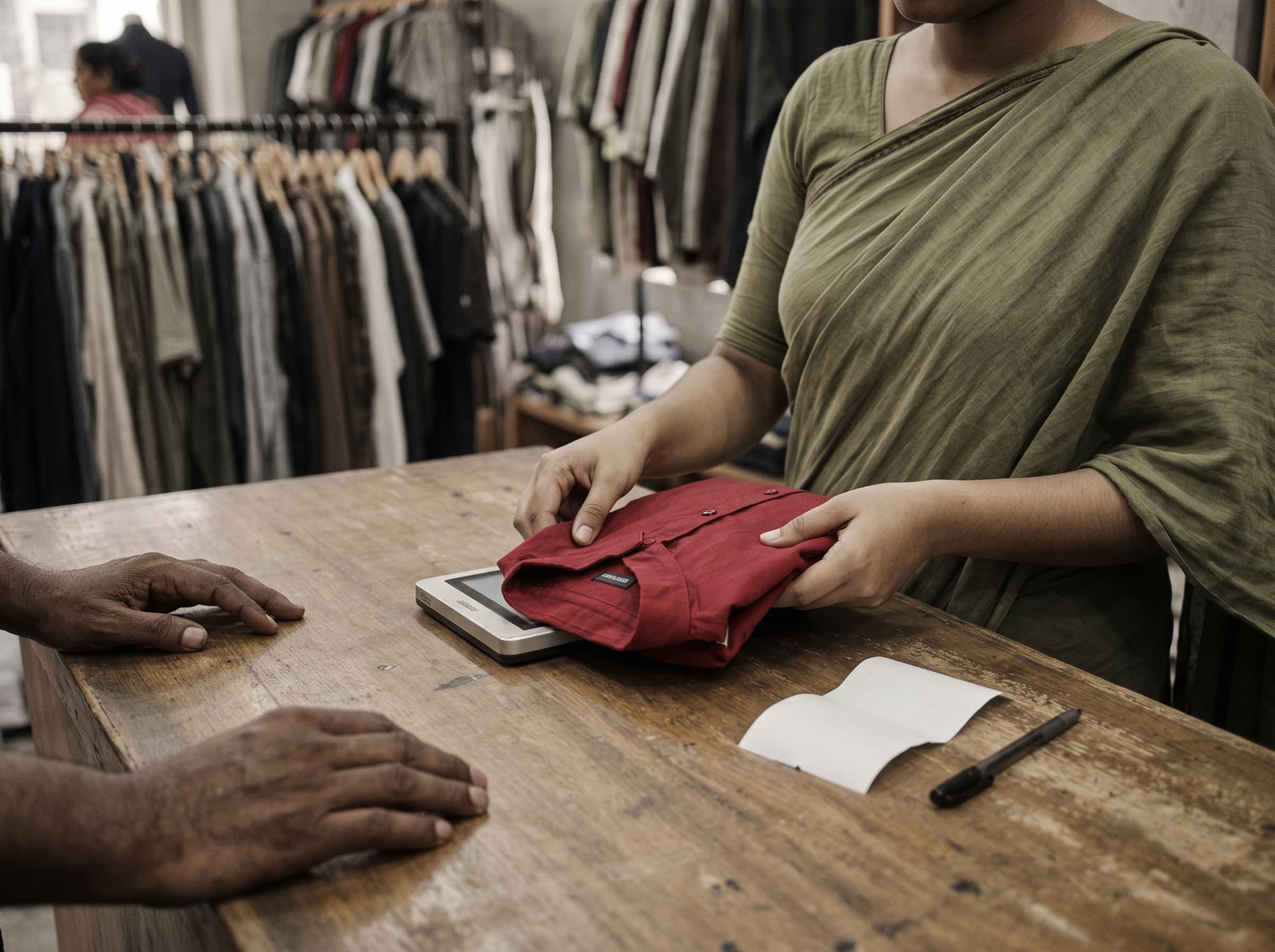
Serialising the unit closes that gap. Each sellable item carries a unique ID written at receiving or at the till, and the sale binds that ID to the transaction. When it comes back, the question stops being 'does this look returnable' and becomes 'is this the item on this receipt, inside the window, from a store we sold it in, with the tamper seal intact'. Four checks, all answerable in under a second, none of them requiring a judgement call from someone facing an angry customer.
The workflow
Four steps, in this order. A step out of sequence is a broken process, not a variation.
- 01
Commission
Each unit gets a serialised UHF tag at receiving, or at the till for lines you tag in store. Tamper-evident labels go on the categories that justify them.
- 02
Sell
The POS posts the transaction and the platform binds the serial to the receipt — store, till, time and price, all recorded against that one unit.
- 03
Validate
At the service desk the tag is read. The rules engine checks item against receipt, elapsed time against your window, store of origin, and tamper status.
- 04
Resolve
Approve, refuse, or route to a supervisor with the reason code attached. Every decision is logged, so the pattern across stores becomes visible.
What it is
made of
Four layers, in the order data moves: a tag is read, the read becomes an event, a rule decides what it means, and a business system acts on it.
- 01
Tags
What carries the identity
- Serialised UHF RAIN labels, item-level
- Tamper-evident labels on high-risk categories
- Dual-function EAS + RFID where gates are already installed
- 02
Readers & edge
What turns presence into an event
- Desktop reader at each service desk
- Handheld for exception handling and bulk commissioning
- Exit gate telemetry for post-incident forensics
- 03
Platform
What decides what the event means
- Tag registry and serialisation
- Rules engine for return eligibility
- Reason-code capture and audit trail
- Exception workflow for gifts and offline sales
- 04
Integrations
What acts on the decision
- POS connector
- ERP
- Existing EAS estate
What we supply
- 01
Serialised UHF label
The unit of truth. One label, one serial, bound to one transaction — nothing else in the system works without this step being done consistently.
- UHF RAIN, 860–960 MHz
- SGTIN-96 encoding
- Commissioned at receiving or at POS
- Available as dual-function EAS + RFID
- 02
Service desk reader
A flat desktop pad at the returns counter. Reads through folded fabric and packaging, so the item does not have to be unwrapped to be verified.
- Desktop pad, near-field tuned
- Reads one item at a time by design
- Audible and visual pass / fail
- USB or network attached
- 03
Tamper-evident label
For categories where the garment gets worn and returned. Removing the label destroys it visibly, so 'the tag fell off' stops being an argument.

- Destructive-face construction
- Void pattern on removal
- Applied at receiving
- Aimed at high-return categories only
What to expect
Ranges, not single flattering figures. Baselines are captured for four to eight weeks before a pilot starts, so the delta is measured rather than claimed.
- Shrink reduction
- 20–40%
- Return approval rate
- Measured, not assumed
- Tamper fail rate
- Tracked per store
- Decision time
- Under a second
What to plan for
Every module has a failure mode. These are the ones that actually bite on this one, and what we do about them — because finding out later costs more than knowing now.
- Customers will attempt tag tampering once they understand the control.
- Tamper-evident labels on the categories that actually attract it, plus a fail rate you watch by store rather than in aggregate.
- Linking purchases to individuals raises legitimate privacy questions.
- The tag carries a serial, not a customer. Personal data stays server-side under role-based access, and consent signage goes at the desk.
Your existing systems
- POS
- ERP
- EAS estate
Where it earns its keep
- Apparel and footwear chains with a generous, abused return policy
- Electronics and high-value retail where swap fraud is the known problem
- Groups already running EAS who want the tagging step to do a second job
Before you
buy
The things operations directors actually ask on the first call.
Do we have to serialise everything?
No, and you should not. Serialisation earns its cost on high-return, high-value categories. We scope which SKUs justify it during the survey and leave the rest on standard tagging.
What happens with gifts, or an item bought at another branch?
Both are configured exception paths, not failures. Gift returns validate against the transaction without exposing price to the recipient, and cross-branch returns are allowed or refused according to a rule you set.
Will this slow the returns counter down?
It replaces a judgement call with a read. In practice the desk gets faster, because the ambiguous cases that used to need a supervisor now resolve themselves.
The rest of retail
- 02
Smart Fitting Rooms
Overhead readers and a wall display that turn the try-on into a conversation instead of a dead end.
- 03
Real-Time Inventory & Automated Replenishment
Item-level reads that keep store and DC stock accurate, and reorder rules that fire on their own.
- 04
EAS & High-Value Item Protection
Gates, tags and detachers you already know — with the incident data they have never given you.
- 05
Fast Checkout & Product Locator
Read a whole basket at once instead of item by item, and find the one unit that is somewhere in the store.
- 06
Supplier Performance & Automated Receiving
Validate a delivery as it comes through the door, and score the supplier on what actually arrived.
- 07
Demand Forecasting & Product Performance Analytics
Movement and sales signals turned into reorder timing, out-of-stock warnings and honest style performance.
- 08
Textile Tracking & Jewellery Security
Apparel tracked from backroom to rail, and high-value pieces counted continuously in the case.
Let's design theright system foryour floor
- Call+880 1713 819528 · 01713 222558
- Emailservice@ratsbd.com
- VisitGround Floor, House-7, Road-13, Sector 14, Uttara, Dhaka-1230
Get your quote
Tell us your store type and city. A specialist surveys your floor, recommends the exact system and sends a clear quote — no obligation.
Request a quote Chat on WhatsApp