Student & Staff ID and Access Control
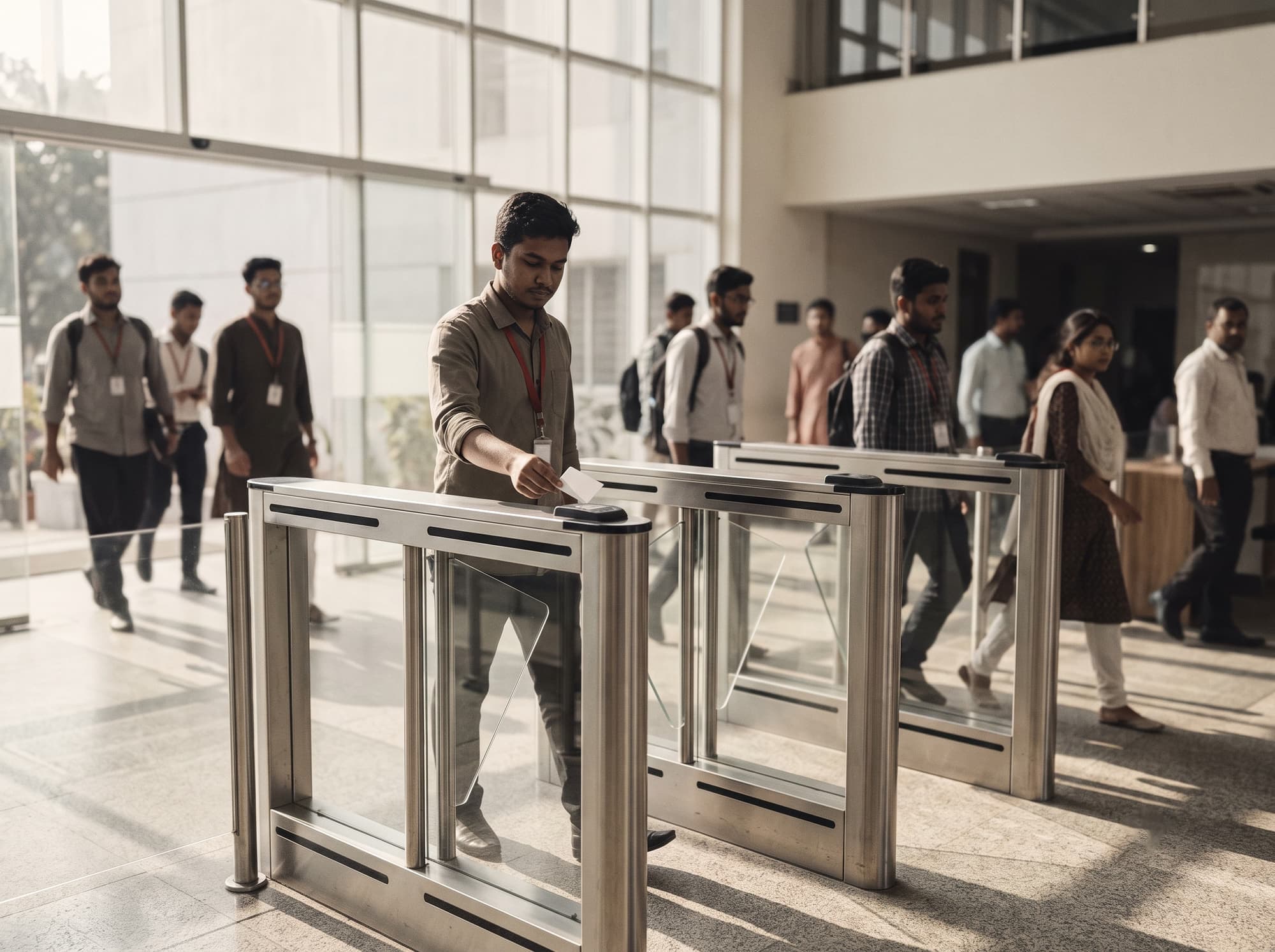
One credential for entry, attendance and library, with access rights that follow enrolment.
The problem it solves
Most campuses issue an ID card that opens nothing, and then run attendance on a paper register that a student can sign for a friend.
The card is already in every pocket; the question is whether it does any work. Making it a real credential means entry policy, attendance capture and library borrowing all run off one thing that is issued once and revoked centrally when someone leaves.
The revocation part is what most institutions underestimate. Keys and mechanical locks mean a departing staff member is a rekeying decision nobody makes; a credential is a checkbox. Access rights that derive from enrolment and HR status rather than from a spreadsheet are the difference between a policy and an intention.
The workflow
Four steps, in this order. A step out of sequence is a broken process, not a variation.
- 01
Issue
The card is encoded and bound to the person's record, with rights derived from enrolment or HR status.
- 02
Enforce entry
Readers and barriers check rights at buildings, labs and restricted areas in real time.
- 03
Capture attendance
Taps at teaching spaces log attendance automatically, replacing the paper register.
- 04
Revoke
Leaving revokes every right at once, centrally, without touching a single lock.
What it is
made of
Four layers, in the order data moves: a tag is read, the read becomes an event, a rule decides what it means, and a business system acts on it.
- 01
Tags
What carries the identity
- HF/NFC ID cards for students and staff
- Optional wristbands for events and halls
- Visitor credentials with expiry
- 02
Readers & edge
What turns presence into an event
- Door readers at buildings and restricted areas
- Flap barriers and turnstiles at main entrances
- Classroom readers for attendance
- 03
Platform
What decides what the event means
- Access policy engine by role and schedule
- Attendance capture and reporting
- Central issue and revocation
- Access violation logging
- 04
Integrations
What acts on the decision
- HR
- Student records
- LMS
- Library ILS
What we supply
- 01
HF/NFC ID card
One credential across entry, attendance and library. Printed and encoded on site, so a replacement is issued in minutes rather than ordered.

- HF/NFC, 13.56 MHz
- Photo ID printed and encoded on site
- Works across access, attendance and library
- Instantly revocable
- 02
Flap barrier
For main entrances where throughput matters. Fast enough that a lecture change does not queue, with a documented failure mode that does not trap people.

- Speed-gate flap barrier
- Bi-directional with anti-tailgate
- Fail-safe open on power loss
- Accessible-width lane option
What to expect
Ranges, not single flattering figures. Baselines are captured for four to eight weeks before a pilot starts, so the delta is measured rather than claimed.
- Access violations
- Logged and prevented
- Attendance capture
- Automatic
- Revocation
- Immediate, central
- Card reissue
- Minutes, on site
What to plan for
Every module has a failure mode. These are the ones that actually bite on this one, and what we do about them — because finding out later costs more than knowing now.
- Legacy locks and existing access systems rarely integrate cleanly, and ripping out working hardware is hard to justify.
- Adapters where the legacy panel supports them, and a staged migration — new and refurbished doors first, legacy doors as they come up for replacement. A campus runs both for a while, deliberately.
Your existing systems
- HR
- Student records
- LMS
- ILS
Where it earns its keep
- Campuses issuing ID cards that currently open nothing
- Institutions running attendance on paper registers
- Sites with restricted labs needing auditable access
Before you
buy
The things operations directors actually ask on the first call.
Can we keep our existing cards?
Sometimes. It depends entirely on what technology they use — many campus cards are low-frequency or magnetic stripe and cannot carry the required security. We test a sample before promising anything.
What happens in a power cut or a fire alarm?
Barriers fail safe — open. Life safety overrides access control without exception, and that behaviour is verified at commissioning rather than assumed from a datasheet.
Is attendance capture reliable enough to be official?
It records a tap by a credential, which is stronger than a signature but not proof of a person. Institutions using it for formal attendance usually pair it with spot checks — we would not claim more than the mechanism supports.
The rest of education
- 01
Audit & Compliance Management
Turn the annual asset audit from three weeks of manual counting into a two-day walk-through.
- 02
IT Equipment & Laboratory Asset Tracking
Know where laptops and lab instruments are between audits, and get an alert when one leaves.
- 03
Library Resource Management with Automated Checkout
Self-check kiosks, security gates and shelf inventory that runs in an hour instead of a fortnight.
- 05
Sports Equipment & Facility Management
Issue, return and maintenance tracking for kit that currently walks off quietly.
Let's design theright system foryour floor
- Call+880 1713 819528 · 01713 222558
- Emailservice@ratsbd.com
- VisitGround Floor, House-7, Road-13, Sector 14, Uttara, Dhaka-1230
Get your quote
Tell us your store type and city. A specialist surveys your floor, recommends the exact system and sends a clear quote — no obligation.
Request a quote Chat on WhatsApp