
Hotel Asset & Equipment Monitoring
Linen, carts, AV and banquet equipment tracked through their cycle, so loss stops being invisible.
The problem it solves
A hotel loses a dozen towels a week and nobody notices, because a dozen towels never appears on anybody's report. Multiply by fifty-two.
Linen is the clearest case. It leaves in guest bags, disappears in the laundry cycle, and gets written off as par-stock replenishment — a recurring cost line nobody questions because nobody can attribute it. Laundry-rated tags survive the wash, so a par stock can actually be counted, and losses can be located in the cycle rather than assumed.
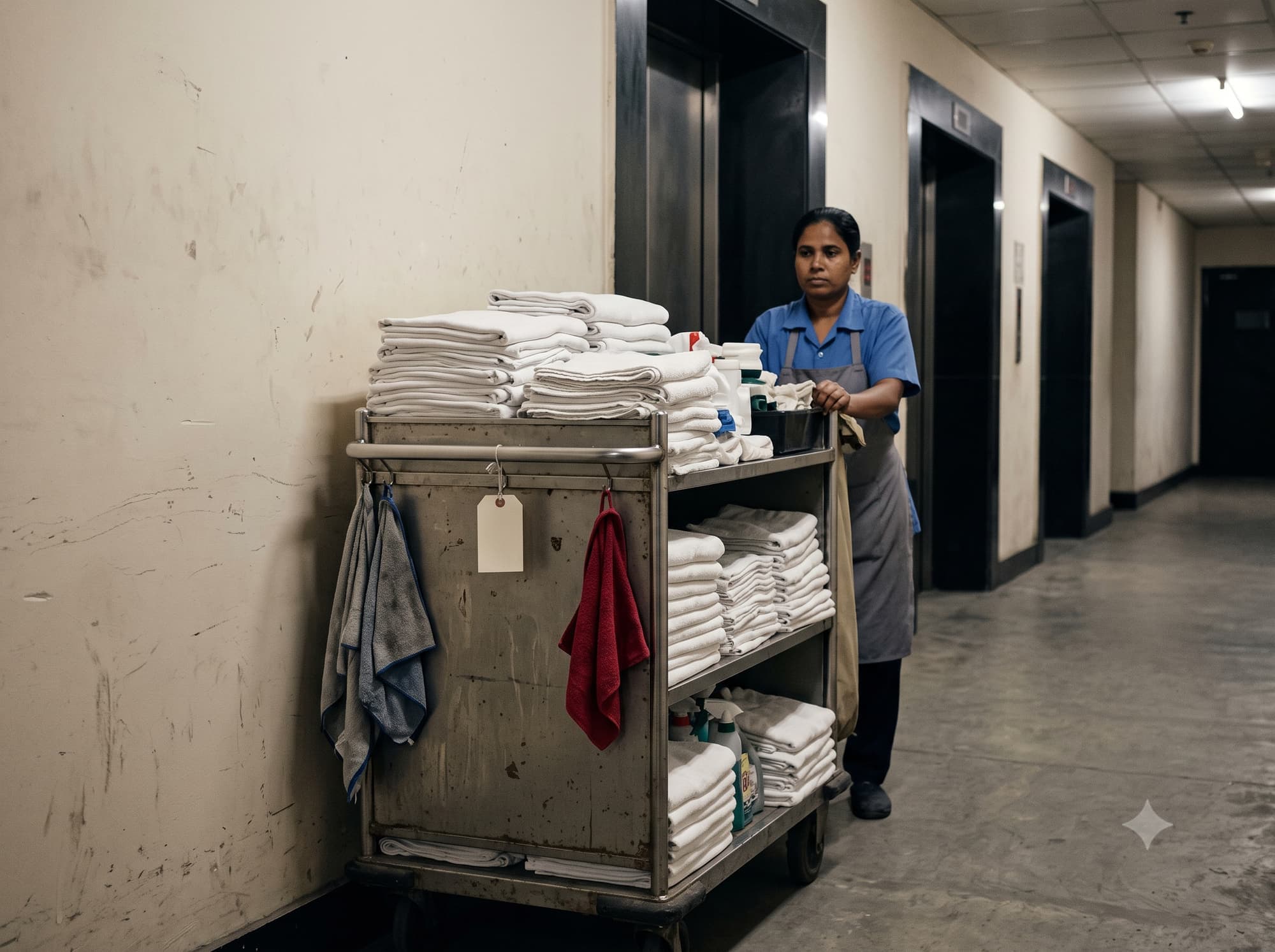
The same ledger covers housekeeping carts, AV equipment and banquet assets: the projector that went to a conference room, the linen trolley that ended up on the wrong floor, the staging that was definitely returned. Audit them with a handheld in minutes, and put maintenance prompts on the items that need servicing.
The workflow
Four steps, in this order. A step out of sequence is a broken process, not a variation.
- 01
Tag
Linen takes laundry-rated tags; carts, AV and banquet assets take standard or on-metal tags with owner and location.
- 02
Issue and use
Items are read out to a floor, a function or a department, so responsibility is recorded.
- 03
Return and count
Laundry and service-area portals count linen through the cycle; handhelds audit assets in minutes.
- 04
Maintain
Service prompts fire on usage or date, and completion is recorded against the item.
What it is
made of
Four layers, in the order data moves: a tag is read, the read becomes an event, a rule decides what it means, and a business system acts on it.
- 01
Tags
What carries the identity
- Laundry-rated UHF tags for linen and textiles
- Standard UHF tags for carts and banquet assets
- On-metal tags for AV and technical equipment
- 02
Readers & edge
What turns presence into an event
- Laundry and service-area portals
- Handhelds for audits and searches
- Optional cart-mounted readers
- 03
Platform
What decides what the event means
- Asset and linen ledger with par stock
- Cycle counting and loss attribution
- Maintenance scheduling
- Department and floor accountability
- 04
Integrations
What acts on the decision
- PMS
- Asset management
- Finance
What we supply
- 01
Laundry tag
Built to survive hundreds of industrial wash cycles at temperature. This is the component the whole linen case depends on — a tag that fails at cycle thirty proves nothing.

- Rated 200+ industrial wash cycles
- Sewn-in or heat-sealed
- Withstands high-temperature and chemical wash
- Same family as campus kit tagging
- 02
Laundry portal
Counts linen in bulk as trolleys pass, in and out. Counting a trolley of towels by hand is not something any housekeeping team will sustain.
- Bulk trolley read
- Direction-aware in / out
- Par stock reconciliation
- Loss attribution by cycle stage
What to expect
Ranges, not single flattering figures. Baselines are captured for four to eight weeks before a pilot starts, so the delta is measured rather than claimed.
- Linen loss
- 30–50% lower
- Par stock
- Counted, not estimated
- Asset audit
- Minutes per area
- Maintenance
- Prompted and recorded
What to plan for
Every module has a failure mode. These are the ones that actually bite on this one, and what we do about them — because finding out later costs more than knowing now.
- Housekeeping process adoption decides whether any of this works. Data nobody generates is data nobody has.
- Mobile-first workflows built around the cart rather than a back-office terminal, with reads that happen as trolleys move through portals rather than requiring a deliberate scanning step.
Your existing systems
- PMS
- Asset management
- Finance
Where it earns its keep
- Properties writing off significant linen replacement annually
- Hotels with banquet and conference AV that migrates
- Operators wanting departmental accountability for assets
Before you
buy
The things operations directors actually ask on the first call.
Do the tags really survive the laundry?
Laundry-rated tags are built for 200+ industrial cycles at temperature. Standard tags are not and will fail early — which is why tag selection here is not a place to economise.
Can we tell where linen is being lost?
You can narrow it to the stage of the cycle — rooms, transport, laundry, or return. That is usually enough to act on, and it is considerably more than 'we bought 400 towels again this year'.
Is this worth it for a small property?
It depends on your annual linen replacement spend. Below a certain volume the tagging cost does not pay back, and we would rather run that arithmetic with you than sell it regardless.
The rest of hospitality
Let's design theright system foryour floor
- Call+880 1713 819528 · 01713 222558
- Emailservice@ratsbd.com
- VisitGround Floor, House-7, Road-13, Sector 14, Uttara, Dhaka-1230
Get your quote
Tell us your store type and city. A specialist surveys your floor, recommends the exact system and sends a clear quote — no obligation.
Request a quote Chat on WhatsApp